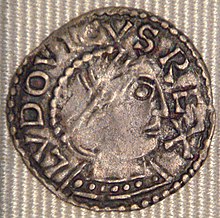
Louis IV (September 920 / September 921[1] – 10 September 954), called d'Outremer or Transmarinus (both meaning "from overseas"), reigned as King of Western Francia from 936 to 954.
A member of the Carolingian dynasty, he was the only son of Charles III and Eadgifu, a daughter of King Edward the Elder of Wessex.[2]
After the dethronement and capture of Charles III in 923, Eadgifu and their infant son took refuge in England (for this he received the nickname ofd'Outremer) at the court of his maternal grandfather King Edward, and after Edward's death, of his uncle King Æthelstan. Louis became heir to the French branch of the Carolingian dynasty after the death of his father in captivity in 929, and was recalled from England by the powerful Hugh the Great, Margrave of Neustria, to succeed King Raoul, who died in early 936.
His reign is mostly known thanks to the Annals of Flodoard and the later Historiae of Richerus. Once he took the throne, Louis wanted to leave the tutelage of Hugh the Great, who, with his title of Duke of the Franks became the second most powerful man in the Kingdom after the King. In 939 the young monarch attempted to conquer Lotharingia; however, the expedition was a failure and his brother-in-law King Otto I of Germany not long after besieged the city of Reims (940). Secondly in 945, following the death of William I Longsword, Count of Normandy, Louis tried to conquer his lands, but he was kidnapped by the men of Hugh the Great.
The Synod of Ingelheim (948) finally allowed the excommunication of Hugh the Great and the final release of Louis from his long tutelage. From 950, the King gradually imposed his rule in the northeast of the Kingdom building many alliances (especially with the Counts of Vermandois) and under the protection of the Kingdom of Germany.
Deposition of Charles III the Simple[edit]
The only child of King Charles III the Simple and his second wife Eadgifu of Wessex, Louis was born in the heart of the Carolingian limited area between Laon and Reims around 920/921. From his father's first marriage with Frederuna (d. 917), he had six half-sisters; and was the only male heir of his father.
On 6 December 884 King Carloman II of West Francia died without a male heir and his half-brother, the future Charles III the Simple, was a five-year-old boy. Because of this, their cousin Charles the Fat, already Holy Roman Emperor and King of East Francia, was invited by the nobles of the Kingdom to assumed the throne. Since the beginning, the new monarch was forced to deal with constant Vikings raids, with little success. After three years of incompetent government, Charles the Fat was finally deposed by the Diet of Tribur (887).[3] Faced with the growing threat of northern invaders, the local nobles again rejected the succession of Charles III the Simple because he was too young, and Odo, Count of Paris (member of the Robertians dynasty) was chosen as the new King of West Francia, after successfully defending Paris against Rollo the Viking. In 893, aided by Archbishop Fulk of Reims, Charles III the Simple attempted to reclaim the throne, in vain. By 897, the young prince only ruled the city of Laon before Odo, on his deathbed, designated him his successor. Following the death of Odo, in January 898, Charles III the Simple finally assumed the title of King of West Francia. Soon, the new monarch showed his ambition to conquer Lotharingia, the main objective of all the monarchs of West Francia since Charles the Bald.[4] However, Arnulf of Carinthia, King of East Francia, prevented this by entrusting the land to his son Zwentibold since 895. However Zwentibold's rule was hated by his subjects, so Charles III the Simple decided to intervene in 898 after being called by Count Reginar of Hainaut. After seizing Aachen and capturing Charlemagne's Palace at Nijmegen, he returned to France at the request of the German bishops. A few years later, in September 911, the Lotharingian aristocracy again called on Charles III the Simple after the death of Louis the Child, the last Carolingian ruler in Germany.
Charles III the Simple was crowned King of Lotharingia in early November 911. However, the constant absences of the new monarch (who preferred to stay in Aachen or Thionville), quickly irritates the Lotharingian nobility (who feared for their own independence) and the nobles of France, who see this inclination as an affront.[5] The situation was even more complicated because, according to Flodoard, Charles III the Simple refused to marched against the Hungarians who threatened Lotharingia (only Archbishop Hervé de Reims was present there) and finally caused an open rebellion when he attempt to dispossess his own aunt, Abbess Rothilde (also mother-in-law of Hugh the Great), from Chelles Abbey in order to give it to his favourite, Hagano (a relative of his first wife Frederuna).[6]
From 920 to 922, Charles III the Simple finds himself in trouble. Although he pacified his relations with Henry the Fowler, the new King of Germany, he had to fight on two fronts: one against Duke Giselbert of Lotharingia and the other against Hugh the Great, irritated by the treatment of his mother-in-law. Defeated, in June 922 Charles III the Simple took refuge in Lotharingia, and the nobles of the Kingdom declared him deposed from the throne, choosing as the new King Robert, Count of Paris, brother of the late King Odo and father of Hugh the Great
Withdrawal of Hugh the Great. Return to France[edit]
During the spring of 936, Hugh the Great sent an embassy to Wessex, inviting Prince Louis to "come and take the head of the kingdom" (Flodoard). King Æthelstan, his uncle, after forced the embassy to swear that the future king will have the homage of all his vassals, permitted him the return to France with his mother Eadgifu, some bishops and faithful servants. However, it is surprising that Flodoard expressly described the coronation without mentioning the election.[13] After a few hours of journey, Louis receives on the beach of Boulogne the homage of Hugh and some Frankish nobles, who kissed his hands. Richerus gives us another anecdote about this first encounter:
-
- Then the Duke hastily brought a horse decorated with the royal insignia. By the time he wanted to put the King in the saddle, the horse ran in all directions; but Louis, an agile young man, jumps suddenly, without stirrups, and tames the animal. This pleased all those presents and caused recognition from all.[14]
Louis and his court began the trip in the direction of Laon which was where had to take place the coronation ceremony.
Historians have wondered why the powerful Hugh the Great called the young Carolingian prince instead to take the throne from himself, as his father had done fifteen years ago. Firstly, he had many rivals, especially Hugh the Black (King Raoul's brother) and Count Herbert II of Vermandois, who probably would have questioned his election. But above all, it seems that he was shocked by the early death of his father. Richerus explains that Hugh the Great remembered his father who had died for his "pretentions" and this was the cause of his short and turbulent reign. It was then that "the Gauls, anxious to appear free to elect their King, assembled under the leadership of Hugh to deliberate about the choice of a new King".[14] According to Richerus, Hugh the Great delivers the following speech:
-
- King Charles died miserably. If my father and us, we hurt your Majesty by some of our actions, we must use all our efforts to erase the trace. Although following your unanimous desire my father committed a great crime reigning, since only one had the right to rule and was alive, he deserved to be imprisoned. This, believe me, wasn't the will of God. Also I never had to take the place of my father.[14]
Hugh the Great knew that the Robertian dynasty had not left large traces in the recent history of the Kingdom; his uncle Odo had died after a few years of reign, abandoned by the nobles. Hugh's father, Robert I, was killed during the battle of Soissons after only months of reign and his brother-in-law Raoul couldn't stop the troubles that multiplied in the Kingdom during his reign. Finally, Hugh still didn't have a legitimate male heir: his first wife Judith (daughter of Count Roger of Maine and Princess Rothilde) died in 925 after eleven years of childless union; in 926 he married secondly with Princess Eadhild of Wessex, full-sister of Queen Eadgifu, who also didn't bear him any children.[15] In addition, the marriage with Eadhild, actively promoted by Eadgifu, was made in order to sever an eventual dangerous link between Hugh and Count Heribert II of Vermandois.[16]
Coronation[edit]
Having arrived on the continent, Louis IV was a young man of fifteen years, who spoke neither Latin nor French, but probably spoke Old English. He knew nothing about his new kingdom and he had almost nothing. Hugh the Great, after negotiating with the most powerful nobles of the Kingdom (William I Longsword of Normandy, Herbert II of Vermandois and Arnulf of Flanders), was appointed guardian of the new King.[17] Louis IV was crowned King by Artald, Archbishop of Rheims, on Sunday 19 June 936,[18] probably at the Abbey of Notre-Dame and Saint-Jean in Laon,[19][20] perhaps at the request of the King since it is a symbolic Carolingian town and he was probably born in this town. The chronicler Flodoard records the events as follows:
| Brittones a transmarinis regionibus, Alstani regis praesidio, revertentes terram suam repetunt. Hugo comes trans mare mittit pro accersiendo ad apicem regni suscipiendum Ludowico, Karoli filio, quem rex Alstanus avunculus ipsius, accepto prius jurejurando a Francorum legatis, in Franciam cum quibusdam episcopis et aliis fidelibus suis dirigit, cui Hugo et cetero Francorum proceres obviam profecti, mox navim egresso, in ipsis littoreis harenis apud Bononiam, sese committunt, ut erant utrinque depactum. Indeque ab ipsis Laudunum deductus ac regali benedictione didatus ungitur atque coronatur a domno Artoldo archiepiscopo, praesentibus regni principibus cum episcopis xx et amplius.[21] | "The Bretons, returning from the lands across the sea with the support of King Athelstan, came back to their country. Duke Hugh sent across the sea to summon Louis, son of Charles, to be received as king, and King Athelstan, his uncle, first taking oaths from the legates of the Franks, sent him to the Frankish kingdom with some of his bishops, and other followers. Hugh and the other nobles of the Franks went to meet him and committed themselves to him[;] immediately he disembarked on the sands of Boulogne, as had been agreed on both sides. From there he was conducted by them to Laon, and, endowed with the royal benediction, he was anointed and crowned by the lord Archbishop Artold, in the presence of the chief men of his kingdom, with 20 bishops."[22] |
During the ritual, Hugh the Great acts as squire bearing the King's arms. Almost nothing was known about the coronation ceremony of Louis IV. Nevertheless, it seems certain that the King would wear the crown and sceptre of his predecessor. It is equally obvious that he must have promised before the bishops of France to respect the privileges of the Church. Maybe he received the ring (a religious symbol), the sword and the stick of Saint Remigius (referring to the baptism of Clovis I). Finally, the new King (perhaps like his ancestor Charles the Bald) used a blue silk coat called Orbis Terrarum with cosmic allusions (referring to the Vulgate) and the purple robe with precious stones and gold incrustations also used by Odo (888) and his son Lothair during his own coronation (954).[23][24]
The young King would quickly become the puppet of Hugh the Great, who had reigned France de facto since the death of his father Robert in 923. Territorially, Louis IV is quite helpless since he possessed only few lands around the ancient Carolingian domains (Compiègne, Quierzy, Verberie, Ver-lès-Chartres and Ponthion), and some abbeys (Saint-Jean in Laon, Saint-Corneille in Compiègne, Corbie and Fleury-sur-Loire) and finally the revenues of the province of Reims. We know that the sovereign has the power to appoint the suffragants of the Archbishopric of Reims. Laon definitely becomes in the centre of the small Carolingian legitimacy, compared with the possessions in the Loire Valley by the Robertians.[17]
Hugh the Great, the second of the Kingdom[edit]
In 936, Hugh the Great was able to gain supremacy over the Kingdom. Its power comes in two forms: from the extraordinary title of Dux Francorum (Duke of the Franks)[25] that Louis IV confirmed over him successively in three years (936, 943 and 954) and his rule over the Marches of Neustria, where he reigned as a truly princeps (territorial Prince). This title was for the first time formalized by the Royal Chancery.[26][27]
Thus the royal diplomas of the second half of the year 936 confirm the pervasiveness of Hugh the Great: it is said Duke of the Franks "in all reigned after us".[28] This content also means that Hugh denies the existence of the principality of Burgundy that Hugh the Black thought he had acquired after the death of his brother King Raoul.[29] Moreover, from the beginning of 937, Louis IV, called by some "The King of the Duke" (le roi du duc)[30] began his efforts to halt the virtual regency of the Duke of the Franks; in the contemporary charters Hugh the Great appears only as "Count" as if the ducal title was taken from him by the King. But Louis IV hesitated about this move, because the ducal title was already given to Hugh the Great by his Charles III the Simple in 914. But a serious misconduct was probably took place at that time, because Louis IV remove the title from him.[31]
For his part, Hugh the Great continues to claim to be the Duke of the Franks. The royal acts show that Hugh that further strengthens its legitimacy. In a letter from 938, the Pope called him Duke of the Franks, three years later (941) he presided a meeting in Paris during which he raised personally, in the manner of a King, his viscounts to the rank of counts. Finally, Hugh the Great had the decisive respect of the entire episcopate of France.

No comments:
Post a Comment